

For most dedicated birdwatchers, binoculars remain the more natural choice for extended viewing with a more immersive experience. That can lead to people overlooking the humble monocular, but a monocular has some genuine advantages over binoculars.
A monocular is a compact optical device with a single optical barrel, designed to provide magnified viewing through one eye. It performs many of the same basic viewing functions as binoculars, but removes the second optical barrel to create a smaller and lighter device
In summary, a monocular:
- is significantly smaller and lighter to carry everyday
- can be easier to use
- is easier to attach to a support for added stability
- is significantly cheaper than the equivalent binocular
As a result, a monocular can provide an excellent option for casual wildlife watching, sporting events, travel, and smartphone digiscoping. Even if you're an avid birdwatcher, a monocular can complement a pair of binoculars.

So which is right for you?
In this article we share the reasons why you may prefer a monocular by comparing the VEO HD2 10x42 binoculars with the VEO HD2 10x42 monocular. The key optical specification of each is almost identical (such as HOYA ED glass and Multiguard-7 coatings), and so the key differences are in the other features and use of each model.
Monoculars vs Binoculars at a glance
Here we summarise the key differences between binoculars and monoculars:
|
Consideration |
Monoculars |
Binoculars |
|
Size |
Smaller |
Larger |
|
Weight |
Lighter |
Heavier |
|
Pocketability |
Excellent |
Limited |
|
One-handed use |
Easier |
Harder |
|
Immersive experience |
Good |
Excellent |
|
Sharing between users |
Easier |
Harder |
|
Support mounting |
Direct if has 1/4” thread |
Needs adaptor |
|
Smartphone digiscoping |
Easier |
Harder |
|
Equivalent product cost |
Lower |
Higher |
If you'd like more information, simply read on.
Reason 1: Monoculars are smaller
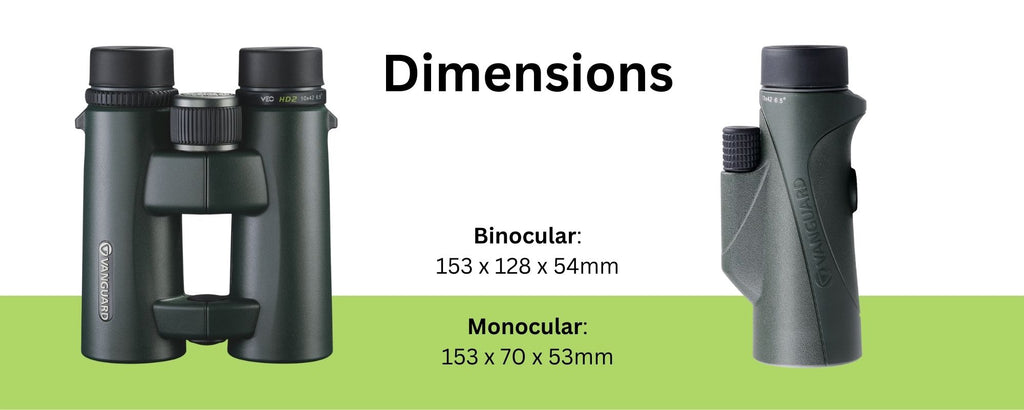
Even folded, a pair of binoculars is bulkier and it's unlikely you'll be able to slip a pair of binoculars into even the largest pocket, let alone taking it out.
At around half the size, monoculars are much more streamlined and are easier to keep to hand as you travel, whether in a jacket pocket, an everyday bag or the glove compartment of your car, making them easier to keep to hand for those unexpected sightings.
Reason 2: Monoculars are lighter
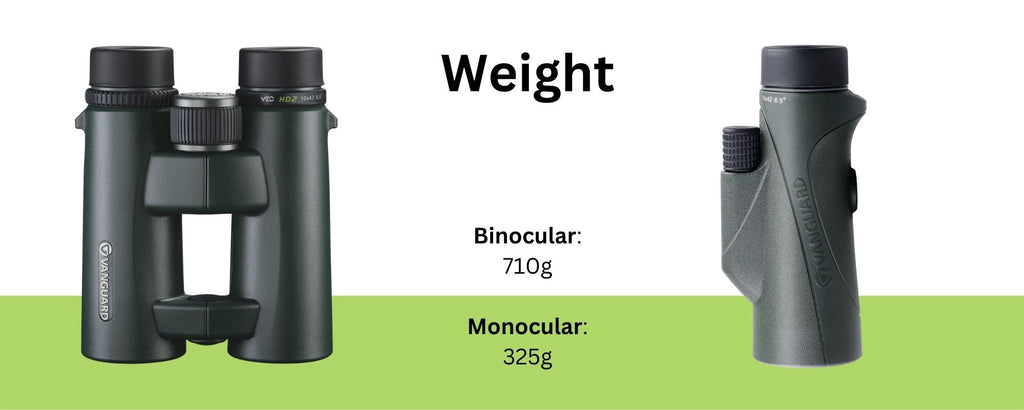
As monoculars only have one barrel and no need for the associated connections, they are generally around half the weight of a pair of binoculars. For example, the VEO HD2 10x42 monocular weighs 385g or 54% less than the equivalent binoculars. This makes them more portable, but also makes them easier to use over extended periods.
Reason 3: Monoculars can be operated with one hand

To ensure the best optical performance, binoculars need to be set up for both eyes. You normally focus one eye using the central focus wheel, then use the dioptre adjustment to compensate for any difference between your eyes. Once set correctly, everyday focusing is done with the central focus wheel. Once set correctly, the dioptre normally needs little attention, and a lockable design further reduces the risk of accidental movement.
The need for the dioptre also makes it harder to share a pair of binoculars as the dioptre may need to be reset every time you share your binoculars for the optimum use. A monocular can just be passed over and refocussed, making it a better tool for a family, couple or even a group.
As a monocular is easy to use with one hand it leaves the other hand free, for example to use a walking stick, carry a bag or hold a child's hand.
Reason 4: Monoculars attach direct to a support
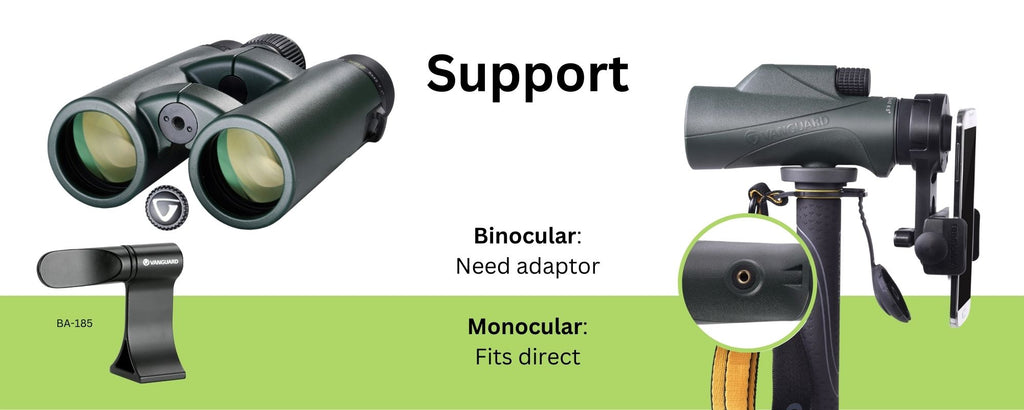
If you're planning to use your optics in one place over extended periods, or need stability for digiscoping, then we'd always recommend using a tripod, monopod or hide clamp.
All Vanguard monoculars include a 1/4" thread on the base so they can be easily attached directly onto a suitable monopod, or to any quick release plate.
To do the same with a pair of binoculars would require an adaptor like the BA-185 Arca. It's not expensive, but it is another cost, and it's something that's easy to forget or lose, which can take away from the enjoyment of your trip.
Reason 5: Monoculars can be easier to digiscope with

Digiscoping is a great way to capture a sighting without the need for a separate camera and expensive lens. You can use either system to digiscope with using an adaptor like the VEO PA-62, but the lighter and more compact design with the simpler focus control makes it easier to digiscope with a monocular, especially if you're not using a support.
Reason 6: Monoculars allows your cash to go further
As you're removing a barrel, you're reducing the materials and complexity from the design. This can deliver significant savings compared to the equivalent pair of binoculars, and allows your budget to go further, or choose a monocular with a better optical performance or more added value features.
Monoculars from Vanguard
At Vanguard we offer a choice of two monoculars:
|
Model |
||
|
Magnification |
8x |
10x |
|
Objective Lens |
32mm |
42mm |
|
Glass |
Optical Glass |
HOYA ED Glass |
|
Prism |
BaK4 |
BaK4 |
|
Coatings |
Multiguard® 4 |
Multiguard® 7 |
|
Field Of View |
131m/1000m |
114m/1000m |
|
Dimensions |
127 x 47 x 70mm |
153 x 53 x 70mm |
|
Weight |
260g |
325g |
|
Best For |
Portability & Value |
Optical performance |
The VESTA 8320M is our starter model with 8x magnification and a 32mm objective lens. Weighing just 260g and measuring just 127 x 47 x 70mm, it's also our most portable.
The VEO HD2 1042M introduces HOYA Extra Low Dispersion (ED) glass in a model with 10x magnification and a 42mm objective lens. The 10x magnification gets you closer to the action, while the HOYA Extra-Low Dispersion glass helps minimise chromatic aberration and colour fringing, improving colour resolution and contrast.
Both models include a wrist strap, carry case, thread for a 1/4" screw to attach to a monopod, a digiscope adaptor and a Bluetooth remote control for iOS and Android.
In Summary
Whether a monocular or a pair of binoculars is better generally depends on use, and here we summarise our recommendations based on some common examples:
|
Main Use |
Monocular |
Binoculars |
|
Casual birdwatching |
Excellent |
Excellent |
|
Intense birdwatching |
Good |
Excellent |
|
Extended observation |
Good |
Excellent |
|
Everyday use (eg. dog walks) |
Excellent |
Good |
|
Concerts and theatres |
Excellent |
Good |
|
Crowded sporting events |
Excellent |
Good |
|
Hiking and camping |
Excellent |
Good |
|
Travelling and holidays |
Excellent |
Good |
|
Smartphone digiscoping |
Excellent |
Good |

In essence the winner is:
Maximum optical performance? Binoculars. If optical performance and immersive use is your overriding priority, then we would recommend binoculars as your best option.
Maximum portability? Monoculars. If having a solution to keep easily to hand at any time, then we would recommend a monocular, delivering magnification in a package that is small enough to keep with you.
That said, it doesn't have to be an either/or decision. A monocular can complement your binoculars by being close to hand everyday, with the binoculars ready for the more intensive and better planned trips.
Frequently asked questions
Here we list some of the questions that we get asked:
I have one eye stronger than the other, which should I use?
Very few people have eyes that have identical focus and a dioptre on a pair of binoculars can normally address this, but it has a limit and depends on the level of difference between each eye. If the optical performance and immersive use is the key benefit then it's worth seeing if there are binoculars that work for you. The best way to do is to visit a local dealer and try out some binoculars for yourself. If the binoculars aren't suitable, or you're looking for a more casual and portable solution, then a monocular may be best for you.
Why do I keep getting dark edges when I look through?
All binoculars and monoculars are designed to have a space between your eye and the eyepiece, and this can vary by person. Dark edges or a restricted view is generally created by the distance not being quite right. To address this binoculars and monoculars use adjustable twist-out eyecups that allow you to position your eye at the correct distance from the eyepiece.
Can I use a monocular with glasses?
Yes you can use either a binocular or monocular with glasses. As the glasses create a distance between the eye and the eyepiece, you would not normally need to extend the eyecup(s) out at all.
Is 8x or 10x better for a monocular?
This comes down to personal preference. 10x magnification will get you that bit closer to your subject, but will also emphasise any movement while you are observing. 8x magnification won't get you quite so close, but gives you a slightly wider field of view so it's a little easier to find your subject and movements won't be quite so noticeable.
Are monoculars good for birdwatching?
Monoculars are good for birdwatching and are easy to keep to hand for everyday use, where the equivalent binoculars will offer a more immersive experience, but you're less likely to have them to hand on your morning dog walk. So it depends on use and there is a good argument to have both for birdwatching as they cover different uses (everyday vs planned trips), if budget allows.
OTHER BLOGS YOU MAY BE INTERESTED IN:
- Choose the right harness for your trip
- Is this the ultimate birdwatching tripod?
- A guide to Digiscoping
- Which series of VEO Binoculars is right for you?
Article Updated: August 2026
Vanguard UK
August 09, 2026
Hi John
Few people have two eyes that focus identically, and so you can focus each barrel on a binocular separately using the dioptre. This video on our YouTube channel hopefully helps explain how this works: https://youtu.be/lb_IbmHGtBE?si=RxBMuSut-n7pmG9f
As long as the difference is within the dioptre range, there is therefore no reason why you can’t use binoculars.
As the message implies a significant difference, we would recommend you look at a system with a lockable dioptre like the VEO HD Series or VEO HD 2 Series. This minimises the risk of the the focus being knocked and so you don’t have to keep correcting it.
Our best recommendation is go to your local dealer and try some different models as nothing beats hands on with a pair of binoculars. If that shows the dioptre ranges are not wide enough, then you can look at a monocular.
Ian at Vanguard
John Banhan
August 09, 2026
I wear varifocal glasses each eye having a different prescription. Would I be better with a monocular
Vanguard UK
January 06, 2025
Hi Nikki
We’re sorry to hear about your impaired vision in one eye. In this case a monocular will probably work better for you.
Binoculars will definitely give you a better 3D view, but that relies on you being able to focus both eyes on the subject. Normally you would use the dioptre to allow you to do this, but there is only so much adjustment you can make using the dioptre, and if the difference between the eyes is extreme, it probably won’t work for you. Only you can say for sure, but I suspect that day-to-day your brain has learned to cope with the difference in the eyes. Put a pair of binoculars in the way and the magnification, the position of the lenses, field of view, etc are likely to undermine that and add complications that the brain needs to work through.
A monocular is designed to use just one eye so you don’t need to worry about the second barrel. Simply use the stronger eye and close the weaker eye and you’re good to go.
As a test before you invest in a monocular, you could try using your binoculars with your good eye, closing your weaker eye as you would with a monocular, and just using the main focus wheel. It will feel odd and clumsy, but it should give you a view of the subject. That way you can see if the optical performance is better than using bother barrels.
If this delivers a better experience, then a monocular will be lighter, smaller and easier to operate and it’s worth looking for the right monocular. If not, then at least you know, but you can still go to a local dealer and try a monocular to see if the real thing works better.
We hope that helps.
The Vanguard Team
Nicki Murray
January 06, 2025
I am effectively one eyed as my vision in one eye is described as useless. As a result binoculars are not really satisfying. Perhaps obvious but a monocular would be the answer. Any advice would be appreciated